Showing posts with label social studies. Show all posts

Wednesday, August 25, 2010

Interactive Whiteboard Teacher Packs

The 2010-11 school year is here. Enhance your interactive whiteboard lessons with MisterTeacher’s new Interactive Whiteboard Teacher Packs. These new teacher packs feature highly engaging resources to include in your lessons combined with new guides on how to use them:

  • Flash Animated Interactive Whiteboard Mini-Movies
  • A Teacher's Guide Full of Engaging Ideas for Using the Mini-Movies on Your Interactive Whiteboard
  • Printable Worksheets that Help You Assess the Concepts You Will Be Teaching with the Mini-Movies

The library of teacher packs is growing and will soon cover concepts spanning all grade levels in both math and science. Here's what currently on the site:

In addition, there are more math and science themed interactive whiteboard mini-movies that are not yet part of teacher packs. A portion of them are available as free downloads. Click here to check out all the Whiteboard Teacher Packs


Don’t forget about MisterTeacher’s web-based student activities: science, social studies, and math activities for elementary through middle grades students.


Sunday, January 31, 2010

New (& Improved) Math & Science SmartBoard Mini-Movies


New Drag and Drop Graphs

I'm very excited to announce three new amazing mini-movies that will allow teachers to really engage their students in lessons on representing data. With these mini-movies, you'll be able to dynamically create three types of graphs: a bar graph, a line graph, and a circle graph. Input your own data into a table, press DONE, and then have your students come to the interactive whiteboard and drag bars, lines, and pie pieces into the correct spots. Once they are finished, have them click the CHECK button to get immediate feedback.

You'll find these new drag and drop graphs in the math mini-movies section of misterteacher.com.

Updated Basics of Geometry Resources

Check out the new basics of geometry student activities. These interactive activities feature play and pause SmartBoard mini-movies that allow students to learn the concepts at their own pace. The mini-movies are also perfect for downloading and using in your interactive whiteboard lessons.
Life Science - Drag and drop food webs and food chains

The newest additions to the science mini-movie library are drag and drop food webs and chains. Teach your students about the flow of energy through a food chain as well as the meaning of words like producer, consumer, herbivore, and carnivore by having them drag organisms to the correct place on the food chains and webs.
Celebrate African American Heritage

Teach your students about the experiences and contributions of African Americans slaves with the web-based unit Slavery in America from misterteacher.com. Each page is printable, making it easy to teach your students about the lives of slaves, negro spirituals, the Underground Railroad, and how African Americans eventually got their freedom.

Saturday, October 24, 2009

New Teaching Resources on misterteacher.com

What's New on misterteacher.com

Clip Art

Rather than offer new mini-movies this month, I've created new pages with a lot of the clip art that appears in them and the related student activities. Teachers can use the clip art in their Notebook presentations or for creating worksheets. You can find the clip art on the mini-movie page, or you can just click below:
  • Alphabet Geometry Clip Art - If you teach geometry concepts with letters, then you'll want to check out this clip art.
  • Everything Geometry Clip Art - Here you'll find triangles and quadrilaterals with the symbols that help kids classify them, types of angles, and more.
  • Dominoes Clip Art - There's a full set of double six dominoes--perfect for teaching addition, subtraction, doubles, and family of facts.
  • Science Clip Art - This modest collection includes some images for teaching various forms of energy.


Math & Social Studies Printables

Introduce your students to writing in the math classroom with a popular resource on misterteacher.com. The 59 printable math prompts that you can find in the Bright Ideas section of the site (click here to see the prompts) are perfect for assessing disposition, learning, and process.

All of the webpages that you'll find in the Slavery in America and Waves of Immigration student activities are printable. Just look for the GRAB IT! button:


The printed pages (or web-based activities) would be perfect for teaching nonfiction reading or as supplements to a social studies curriculum. You can use them to teach about the following:

Look for more mini-movies in the weeks ahead. For immediate updates, follow misterteacher.com (jtubbs) on Twitter.


More Social Studies Resources: Declaration of Independence | Constitution WebQuest

Technorati Tags: | |


Friday, March 13, 2009

Using Google Map Mashups for Social Studies Projects

I just assigned a social studies project to my fifth graders this week on Westward Expansion. It's a collaborative project that requires them to take the role of a character (a prospector, a settler/pioneer, or a mountain man) and describe a trip west that this character would take during the 19th century.

While researching routes, one group decided to use Google Maps to see if they could find the Oregon Trail. I thought this was a cool idea and wished that I had thought to include that web tool in the project. Since then, I've been thinking of ideas for how I would have used Google Maps with this project. Unfortunately, the power of the software I think is creating your own maps & Google requires users to create an account to do that. A Google account offers a few too many features (since it provides an email account, search history, and more) than I feel my students need.

There are however quite a few Google Maps mashups on the Internet that teachers can use in place of Google Maps itself. They also require an account, but to get one students would only need to create a fake email address and username and password. After searching through my bookmarks, I found a couple that I think would work very well in a classroom environment.
  • Quikmaps allows you to perform many of the functions that Google Maps does: add markers, connected lines, and text labels. I created a map below using every function available except for scribbling. Click on the markers for descriptions.


I could easily envision having my students create a map for social studies. A number of topics in history would lend themselves to a similar type of map as the one above: The Underground Railroad, The Trail of Tears, Westward Expansion (trace the path of the famous wagon trails, Age of Exploration (trace routes of famous explorers like Magellan), and much more. What a cool way to integrate geography with history!

I can also see using these maps on my SmartBoard. I'm wishing I would have created one when I taught my students about the Erie Canal. An interactive map in the front of the classroom that traced the route of the canal--complete with markers--would have been extremely helpful to my students.
  • Wayfaring is another Google Maps mashup that I've tried out. This one provides essentially the same features but in a different manner. After signing up, you create your maps in a series of guided steps. Whereas Quikmaps provides the tools (map in the center, markers to the side, etc.) with little guidance, on Wayfaring you must use a map editor that directs you through a series of steps to create markers and routes.
I prefer learning to use the mashups without the guidance and I think my students would have no problem figuring out how to use them. As a result, Quikmaps seems like a better fit for the classroom.

Technorati Tags: | | |

Friday, January 16, 2009

Learning about Emancipation

It's been one of my beliefs for years now that one of the best ways to improve your teaching is simply to learn more about your subject. This is particularly true for elementary teachers--we don't have nearly the content knowledge that our colleagues at the secondary level have. That's why I believe we should all make the effort to learn more about the subjects we teach: more about history, economics, geography, culture, and government in social studies; more about physics, chemistry, life science, astronomy, and geology in science; more about algebra, geometry, number theory, data analysis, and probability in math.

This Tuesday Barack Obama will take the oath of office by putting his hand on the Abe Lincoln's bible. As you know, Abraham Lincoln was the president responsible for the Emancipation Proclamation, the document that freed slaves from the Confederate states. But how much do you really know about the history surrounding this document? Here's a link to a podcast from the NPR show On Point with Tom Ashbrook that will help those teachers interested in learning more about it. The show's title is called Remembering Emancipation. Listen and learn!


Technorati Tags: | | |

Check out: Slavery in America | Waves of Immigration | Declaration of Independence

Monday, January 05, 2009

From Hobby to Business - Incredible Social Studies Resources

As a fifth grade teacher, it's my job to introduce my students to a broad range of content that covers all sorts of subjects within social studies--history, economics, geography, culture, and government. The social studies resources that I've added to my site support standards in the People in Societies and Government strands of the Ohio Academic Content Standards. Two subjects, immigration and slavery in America, were ones that I thought were taught in just about any elementary school in America. Here's a rundown of what is now available at my site:
  • Waves of Immigration: 1892 - 1954 - This resource totals five webpages and describes the waves of immigrants that passed through Ellis Island. Two pages are dedicated to Ellis Island: one that delivers a brief history and the other telling what it was like for the immigrants when they registered there. Two other pages describe the immigrant experience when they arrived in America. All of the pages are printable so teachers can give students a hard copy--just click the Grab It! button.
  • Slavery in America - Another resource totaling five web pages, Slavery in America focuses mostly on the life of slaves in the United States. Topics include Negro Spirituals, Slave Narratives, the Underground Railroad, and the Emancipation Proclamation. These pages are not yet printable but will be very soon!
  • Declaration of Independence - I also have included a one page article on the Declaration of Independence. It talks about what is written on the document and explains a little of the history behind it. This page is printable.
Don't forget about the Constitution WebQuest - not really a WebQuest, but a quiz that takes students all over the Internet to find the answers to the questions. It is interactive and provides students with immediate feeback.

If you teach at the intermediate level, then these resources are perfect for you. Check them out and then pass them on, link to the site, print the pages, etc. Remember, they are all free!

Technorati Tags: | | |

Also Check Out: Tessallations | Teaching Photosynthesis

Wednesday, September 03, 2008

Additions to misterteacher.com

This summer I was able to make some additions to the misterteacher.com website. First is the Constitution Webquest. It's kid-tested and in the form of a quiz (just like the Rainforest Webquest) that requires students to follow links to websites that will help them answer the questions. Second is an addition to the Alphabet Geometry website. Joining the pages on transformations, angles, and tessellations is a new page on parallel lines. Just like the rest of the site, it teaches the concept through animations and is interactive.

Head on over to misterteacher.com and check out the new material.

, , , ,

Monday, July 21, 2008

Looking for the Second Right Answer in Social Studies

It was becoming more than I could take. Each morning and afternoon of the school day, the sound of an unhappy sigh from my students would briefly fill my classroom. Curiously, it always accompanied the announcement from me that it was time for social studies. My students loved learning about science--the subject comes easy to me and I am able to teach it in a way that most students find interesting and fun--and that part of class was often enjoyable for them.

Social studies was different though. I often struggled with how to make concepts like history and geography interesting to my students. Throughout the past school year, I refashioned many of lessons and introduced new projects, all in an effort to make the subject more interesting. My efforts were partially successful--social studies became a little more interesting to a few more students.

A good teacher is continually looking for new approaches to teaching subject matter. We often find them in workshops or conferences. Over the past few years my best ideas have been inspired by my reading of business books. Books like A Whole New Mind, Made to Stick, and now A Whack on the Side of the Head by Roger von Oech. Originally published in 1983, the book is still incredibly useful for those looking for tips to be more creative. It has a lot of useful information for more than just business people; in fact, it's every bit as useful to just about any one looking for ideas for how to be more creative. Which brings me back to social studies...

I have to admit that although I enjoy learning about history, I am not very good at remembering what I learned. Too often, I learn about historical events through reading about them or watching a television show. This is far too passive as I'm not really thinking deeply about what I've seen or heard. This depth of thinking is also what is missing from my teaching of social studies. I give my students some guiding questions, have them read the textbook, and then I try to engage them with a visual slide show that summarizes the reading. Students are learning that their job is to search for the right answer. Who did this or that? When did this event occur? Etc. Which brings me back to the A Whack on the Side of the Head...

von Oech states that to be more creative, we should look for the second right answer. One way to do this is to ask questions that solicit more than one answer. Another is to ask questions in a different way. This got me thinking about the questions that I ask my students to answer when learning about history. So often they are the type that require students to find the right answer. So I've been thinking about how I could get them to look for the second, third, or even the tenth right answer. What I've found is the mental lock of teaching history as a collection of right answers is something that I am going to have a difficult time breaking free of. I wanted to include some examples of questions that require searching for the second right answer in this entry, but I'm having a difficult go of thinking of them.

This will be one of the big challenges that I face this coming school year--including more opportunities in social studies to develop creative thinking through the asking questions in different ways.

Technorati Tags: | |

Check out: Rainforest Webquest | Digital Cameras in the Classroom | Alphabet Geometry

Friday, January 25, 2008

What I Like About Ask.com

This week my students started a project in social studies called Three Worlds Collide. Their task is to research one of the three cultures that collided in the early history of our country: European, Native American, and African.

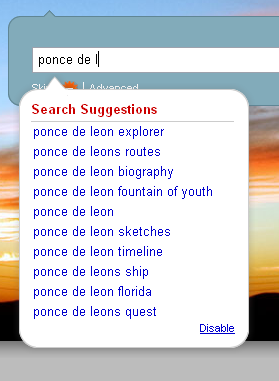
I wanted to make sure that my fifth graders would be successful in their research from start to finish. This meant that they must first know what questions to ask before even beginning to look for information, something difficult for kids at this age to do. It's also difficult for kids to think of the proper search terms to put in a search engine. Enter the search assist function of Ask.com. When searchers enter a term in the window, several possible keywords and phrases drop down (see example below). This is extremely helpful for the young student who has trouble knowing what to begin researching.


Yahoo also has search assist. I'm not as excited about it though. You get a full menu with Ask.com whereas the Yahoo assist is a scrolling menu. Plus, the Yahoo search page is full of all sorts of other distractions and this makes the search window hard to find.


I had my students write down the search suggestions that Ask gave them and then use them as "guiding questions." We'll see on Monday how much they helped.


Technorati Tags: , ,

Check out: Rainforest Webquest | Digital Cameras in the Classroom | Alphabet Geometry

Friday, December 14, 2007

Concrete Experiences and the Brain


How do I get my students interested in social studies? This has been one of the big challenges I have taken on this school year. My efforts have lead me to the book Made to Stick, a book about how ideas become sticky. I've been reading the book for a while now and using the ideas from it to try to liven up material that fifth graders have a hard time getting interested in--history, economics, and geography. Many of the concepts embedded in these topics can be a little abstract--how does one define economy for a 10 year-old--so my students have a difficult time learning them.

One of the six traits that the authors assert make ideas sticky is concreteness. Take an abstract idea and make it concrete, and people will remember it. Concrete messages evoke the senses, and the more senses they call up, the stickier they are.

An article in the December/January edition of the journal Teaching Children Mathematics actually explains how the brain processes sensory experiences. The part of the brain sensitive to sensory input is the sensory cortex. "Sights, sounds, touches, smells, tastes and muscle sensations children experience all go this part of their brains" the authors state. So it makes sense to use it as a starting point for learning. What kind of sensory experiences can we use to make learning stick with our students? Below is a list:
  • Manipulatives
  • Field Trips
  • Projects
  • Role Playing
  • Visual Representations
  • Sharing and listening to ideas
Thanks to the above reading, I've been able to brainstorm (and use) new ideas for helping my students learn social studies better. For instance, when teaching about the history of the Southeast Region of the United States, I plan to use cotton balls in some way (not sure yet) and relate them to the region's agrarian economy and dependence on slavery. I've even become open to ideas from colleagues that I may not have used before (a suitcase--what would we pack it with if we were traveling to a certain region of the country).

Photo Credit


Technorati Tags: , ,

Check out: www.misterteacher.com | Digital Cameras in the Classroom | Alphabet Geometry