1. Have your students make their own nature films - Wildlife Filmmaker is a cool toy from National Geographic that allows users to make a nature film complete with animal clips, sounds, music, and more. It's easy to use and doesn't take too long. Your kids should be able to make a movie in as little as two class periods.
2. Check out the Killer Clips at animalplanet.com - Sink your teeth into some of the wildest video on the planet. Then get the Killer Clips widget and embed the videos into your website (see below).
Click here for 8 more bright ideas for the science classroom.
Showing posts with label nature. Show all posts
Showing posts with label nature. Show all posts
Tuesday, January 27, 2009


Friday, November 07, 2008
Fall is a Great Time to Teach About Photosynthesis
With the change of season comes less daylight. Less daylight results in the fall color change for trees. This makes a great time to teach your students about how plants use sunlight to change water and carbon dioxide into glucose through photosynthesis. Fall is an excellent time because it allows teachers to put the process into a context that the kids will likely remember.
Being able to explain why a leaf changes from green to yellow (or any other color) requires knowledge of how plants capture sunlight (they use the pigment chlorophyll). Since this is the case, why not just teach the whole process? Below is a list of links that I've gathered that explain why leaves change colors in the fall.
Being able to explain why a leaf changes from green to yellow (or any other color) requires knowledge of how plants capture sunlight (they use the pigment chlorophyll). Since this is the case, why not just teach the whole process? Below is a list of links that I've gathered that explain why leaves change colors in the fall.
- Kidszone - Autumn Leaves - Simplified explanation for younger kids.
- Science Made Simple - Why do Leaves Change Color in the Fall? -
- The Miracle of Fall - A collection of links for teaching about the changing of leaves
- Leaf color change animation - Watch a leaf change from green to yellow from Oct. 1 to Oct. 31
- Foliage Network - The Foliage Network was developed to provide accurate foliage information for various locations across the United States.
Monday, November 03, 2008
"Selling the Day" in the Classroom

It was a beautiful day for a field trip to Stearns Woods. Indian Summer had brought sunny skies and temperatures in the 70s, unseasonably warm for early November. The forest was alive with the color of yellow, orange, and red leaves that were completing the final phases of their fall color change.
My students' job on this trip was to capture the brilliance of the color change with digital cameras and use their photos to create a digital story. There were just enough science standards (photosynthesis, Earth's cycles) involved to justify the trip and the resulting project. Throughout the trip I was impressed by how engaged my students were in taking photos of leaves, dead logs, fungus, and other items from the forest. But the most gratifying part came on the walk home.
It was at this time that I heard a couple students bickering behind me. When I looked back to see what the problem was I noticed that one student was trying to take a leaf away from another. The leaf was from a gingko tree (pictured above) and evidently the student thought it was neat enough to not only bring it back to school but also keep it from somebody else. It seemed like a lot of fuss over something as simple as a leaf; however, he was not the only one. And there was a good reason for the fuss.
In preparation for the trip, I had shown the class one of these leaves and talked about how unique I thought it was, even stopping to stare at it for a brief moment. I told them that there were a few gingko trees in Stearns Woods and I challenged them to find one. It was obvious that I thought the leaf was a small treasure and through my actions I was passing on my enthusiasm for it to my students. My approach was not unique to just the gingko leaf. I have "channeled" my enthusiasm for other classroom activities on many occassions. I often begin talking about upcoming projects weeks or even months in advance. I show photos from previous years' classes and I tell my students that they won't believe what they will be able to create with the knowledge they learn from my teaching.
In a way, I feel like I've become a salesman. By the time we get to certain units, my students can't wait to begin. I'm very aware of what I'm doing when I'm "selling" the learning to my students. But today, with the gingko leaf, it really hit me how inflluential we as teachers can be when we show a little enthusiasm for what we are doing. It made me think of the following quote from Haim Ginott (shortened):
"I have come to a frightening conclusion.Keep this post in mind the next time you want students to buy into your teaching. Remember, with enough enthusiasm you can even make a leaf a prize to some kids.
- I am the decisive element in the classroom.
- It is my personal approach that creates the climate.
- It is my daily mood that makes the weather.
- As a teacher I possess tremendous power to make a child's life miserable or joyous.
- I can be a tool of torture or an instrument of inspiration."
Monday, June 30, 2008
Why I Love Internet - Reason #1 - Identifying Snakes
 Remember when you were a kid, fascinated by a meandering creek or stream? Think back to how fun it was to turn over rocks and search for critters like frogs and crawdads. I still enjoy roving creeks and streams, searching for wildlife; not so much because I've managed to hang on to that childhood fascination, but more because I want to pass it on to my kids.
A couple weeks ago the four of us (Anna, Andrew, and Audrey are my four year old triplets) we're roaming a creek close to our house when Anna came across a small snake. "A snake, Daddy!" she yelled as I dashed up to where she was standing. I managed to catch a glimpse of it as it slithered under a rock. It was small with a very attractive pattern on its back. With thoughts of Steve Irwin in my head, I lifted up the rock and had every intention picking up the snake and allowing my kids to observe it and even touch it. The snake had other thoughts.
Ignoring the fact that the snake was coiled in a defensive pose and was ready to strike, I reached down, grasped it by the tail (or the end furthest from its head), and picked it up. It did not want to be picked up. It immediately began thrusting its head up towards my hand, trying to bite me. After a few tries, it was successful. I dropped it to the ground, and, undeterred, I again reached down to grab the snake, and, for a second time, he bit me. One of the strikes broke the skin, though no more than a paper cut would.
What was I thinking? Why would I continue to pick up an aggressive snake? For one, the snake was small and far from frightening. Furthermore, I was in no danger from its bite; living in Ohio, I was sure that the bites had released no venom because there are no poisonous snakes where I live. I'm no biologist though, and a slight sense of anxiety lingered throughout the rest of our trip to the creek.
When I got home, I jumped on the computer and googled "Ohio snakes." The first result was a page called "What's That Snake?" from the Ohio Public Library Information Network (OPLIN). The site allows you identify snakes based on their markings by taking you through a series of screens, each with a pair of choices. Your job is to try to determine which of the two choices better fits your snake, and then go on to the next screen.
Anyway, using this identification system I was unable to figure out precisely what the snake was that bit me. My anxiety grew a little after one of the possibilities turned out to be a Northern Copperhead! Luckily though, the Eastern Milk Snake and the Kirtland Snake also resembled the one that bit me. I've experienced no ill effects of the bite, so it obviously wasn't the copperhead.
Since that trip, I've repeated my searches with spiders, leaves, and even salamanders. Having the Internet as a resource has turned me into an amateur biologist and once my kids are old enough, I'll have them searching with me.
Monday, June 02, 2008
A Field Trip to Stearns Woods

Inspired by my reading of the book Last Child in the Woods by Richard Louv, one of my goals this school year was to take my students on a field trip to Stearns Woods, a local forest within walking distance of my school. My hope was that this field trip would have outcomes way beyond helping my kids get better test scores; this was field trip I wanted to take because I believe that school should consist of more than preparing our students for standardized tests. Last summer I introduced my own kids to a forest near my house. After witnessing the enjoyment they got out of running down the trails and playing in the creek, I was sold on the ideas that Louv presented in his book. I wanted to my students to have these experiences also. So the outcome I was hoping for was that this field trip would expose them to a natural area close to their homes and perhaps they would be motivated to visit it again.

As I started planning our trip, I realized that it was an opportunity for much more than a nice morning or afternoon wandering around the woods. I could develop a major project, one that would incorporate several forms of digital media, based on our trip to the woods. I decided to divide the kids into six groups and on the day of the trip armed each group with a digital camera. With the cameras they would take photos of various plants, trees, animals tracks, and fungi, each one evidence of the biodiversity of the woods. They would then use these photos in iMovie to make a slideshow (complete with vocals, music, titles, etc.) that explained the importance of the woods for the city of Wyoming.

As expected, my students were extremely excited about using iMovie. Before taking the trip, I checked out the computer lab for a couple days so that they could get some practice with it before creating their actual slideshows. With me giving simple directions here and there, they quickly learned how to use the software and were putting together slide shows in no time. It didn't take long for them to begin asking if they could incorporate music. I knew that they would be able to import music from CD's, but it was at this point that I seized another opportunity--to have my kids check out the royalty free music that was hanging out on the Internet, free and easy-to-get. Moreover, they could learn about the importance of attributing the music to its author.
I've taken a look at some of the completed slideshows (but have yet to grade them), and I have to say that they need a little work. But this was my first iMovie project and for most of them theirs too. Next year I'll go back to the drawing board and make the necessary adjustments so that the final products show significant improvement. Anyway, isn't the process is almost more important than the final product?
Technorati Tags: education| nature | Richard Louv | iMovie
Check out: Rainforest Webquest | Digital Cameras in the Classroom | Alphabet Geometry
"Look for the Second Right Answer." Roger von Oech
Sunday, February 10, 2008
More on Videophilia and Nature
Epistemic Games is another one of the blogs on my blogroll. They've also read the article about the decline in national park attendance and its correlation with a rise in videophilia. Here's their take on the study by the Nature Conservancy.
Technorati Tags: education | video games | nature | Epistemic Games
Technorati Tags: education | video games | nature | Epistemic Games
Tuesday, February 05, 2008
Wired News: Nature Giving Way to Virtual Reality
"As people spend more time communing with their televisions and computers, the impact is not just on their health, researchers say. Less time spent outdoors means less contact with nature and, eventually, less interest in conservation and parks.Wow...It seems that Richard Louv was correct. In his book, Last Child in the Woods: Saving Our Kids from Nature Deficit Disorder, Louv spoke of precisely the same issues that are covered in the Wired article. One of these is the decline in national state park visits. From the article:
Camping, fishing and per capita visits to parks are all declining in a shift away from nature-based recreation, researchers report in Monday's online edition of Proceedings of the National Academy of Sciences."
Now I can't say that I think the declines are caused by kids playing video games, but I definitely buy into what is being written about kids spending less time outdoors. And it scares me to death that this is leading to less of a concern for nature and conservation. Hopefully, parents will catch wind of studies like this and books like Louv's and provide their kids with more experiences like the one I wrote about this past summer."By studying visits to national and state park and the issuance of hunting and fishing licenses the researchers documented declines of between 18 percent and 25 percent in various types of outdoor recreation.
The decline, found in both the United States and Japan, appears to have begun in the 1980s and 1990s, the period of rapid growth of video games, they said."
Technorati Tags: education | video games | nature
Check out: Rainforest Webquest | Digital Cameras in the Classroom | Alphabet Geometry
Monday, December 17, 2007
A Great Resource for Digital Images

Looking to spice up a so-so lesson with some incredible visuals? National Geographic has a little eye candy to offer in its awesome gallery of photos. For those of you looking to bring digital images into the classroom, there are plenty to choose from here. Many of the categories are pretty common among image sites, but there are others like Patterns in Nature and Adventure and Exploration that you probably won't in many other places.
Saturday, September 01, 2007
Acadia: No Windshield Tour for Me

"I am well again, I came to life in the cool winds and crystal waters of the mountains..."
--John Muir
My recent trip to Acadia National Park was a great experience that reinforced in many ways what I have been reading about in Richard Louv's book Last Child in the Woods: Saving Our Children from Nature-Deficit Disorder.
Technorati Tags: Acadia, education, books, Maine
--John Muir
My recent trip to Acadia National Park was a great experience that reinforced in many ways what I have been reading about in Richard Louv's book Last Child in the Woods: Saving Our Children from Nature-Deficit Disorder.
- Primary vs. Secondary Experience - No windshield tour for me - My friend and I hiked over 10 miles of the park's trails through boreal forest, over three peaks (including Cadillac Mountain), and along the craggy coastline. Our park experience was far more intimate than that of the "windshield tourists" that we came across at the summit of Cadillac Mountain. We encountered multiple ecosystems (tidal pools, bogs, and the forest), observed rock formations created by glaciers, and, best of all, got to experience the solitude of the park--something only those who wander off the beaten path can do.
- "Restorative Environment" - Speaking of solitude, certain areas of the park were remote enough to allow us to enjoy something that is nearly impossible outside of nature--pure tranquility. Sitting on a mountaintop, the only things that broke the silence were the occasional dragonfly clicking by or a breeze rustling the conifers. By the second day of the trip, my body felt completely relieved of any stress.
- A sensory experience - The atrophy of the senses is an important topic that Louv covers in his book. Without much direct experience with nature, many people become two dimensional--visual and auditory--when it comes to their senses because that is what the electronic world offers. Being in the heart of Acadia--on the trails--I not only used my sight and hearing, but also smell, touch, and taste. The boreal forest has much to offer those who senses are rarely tested--the cool air, the different smells of nature, and blueberries growing wild.
Technorati Tags: Acadia, education, books, Maine
Friday, July 20, 2007
What Makes a Good Field Trip?
 Yesterday I completed a week long science course called the Southwest Ohio Science Institute. The purpose of the course was to give area teachers the knowledge we need to implement an inquiry-based approach to teaching science standards. During the week we covered such topics as the properties of water, the cycles of the earth and its place in the solar system, and thermal energy. Activities were often conducted using inquiry, meaning they were hands-on and followed a series steps--engage, explore, explain, and elaborate. The only day that we did not learn through this was approach was Tuesday.
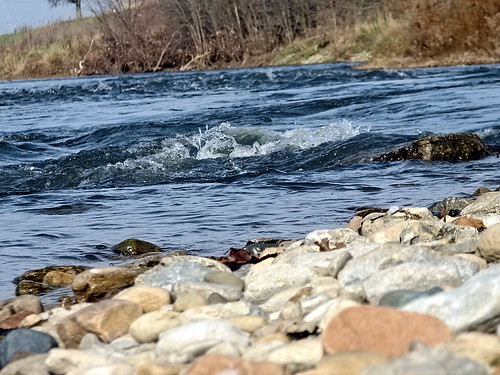
That day, by far the most enjoyable for me, was field trip day. Sixteen of us were given a tour of a wastewater treatment facility and the Bolton Water Treatment Plant with a trip to the Great Miami River to do some stream testing tucked in the middle. The tours of the treatment plants, conducted by knowledgeable representatives, did far more for my learning of the water treatment process than any diagram, explanation, or even video could have done. Physically moving around the facilities and seeing the different steps involved engaged me at a different level.
The trip to the river was even more powerful. As a teacher, almost ALL of the learning I do is pedagogical. The goal of so many courses or workshops for teachers is to improve our teaching by introducing us to new instructional strategies. On Tuesday, I had a different experience--I got to do the work of a real scientist.
Our group got to do some basic water quality tests on the river. We did this in two ways: (1) wading into the river and searching for certain pollution tolerant macro invertebrates and (2) running chemical tests on the water, looking for certain pollutants. It might not have been sophisticated work, but it still gave me the feeling that I was doing something a real scientist might do.
The whole day got me thinking: What makes a good field trip? It seems like so many of the field trips I've been on with my students were planned with good intentions, but were really no better than a watching a video (museum tours). Other trips were planned because the experience was one we thought the kids should have (watching a film on an IMAX screen). However, are these the type of trips kids should be taking? Would a scientist consider a trip to the movies field work?.
Monday, July 02, 2007
Your Local Woods: A Cure for Nature Deficit?

One of the highlights of my summer break so far has been taking my kids to the local forest preserve to hike the trails and play in the creek that runs through it. All three of them really seem to enjoy spending time there. They are only three years old and without these trips, it's possible that they could have very little exposure to nature during their childhood.
I just can't let that happen. As a child, I spent a great deal of time running through the woods in my neighborhood and as a result, I am comfortable in natural settings. Unfortunately, there are many people my age who haven't really spent much time in the woods or any other natural setting. It's not surprising that they have no appreciation for nature at all.
With this in mind, I was recently turning through Backpacker magazine when I came across an article titled "Wilderness Kids," about a group of kids who took part in a 600-mile wilderness expedition in Vermont. The journey was called the Vermont Semester and was organized by a group called the Kroka Expeditions adventure camp to revive "the wilderness journey as a rite of passage." The founder, Misha Golfman, sees more kids on medication with flickering attention spans due to stunted imaginations from lack of exposure to nature.
According to research cited in the article, Golfman is correct. Diagnoses of ADHD have skyrocketed at a time when visits to national parks have declined. Other research has shown that children as young as five showed significant reduction in ADHD symptoms when they engaged with nature. Several books have been published on nature deficit disorder. Author David Sobel makes the point that we can't expect kids to become concerned about big environmental problems if we don't give them positive, direct experiences with nature first.
As much as I love technology and advocate its use in the classroom, I believe that we must balance its use with time in natural settings. Put the iPod away, turn off the television, shut down the computer, and get out to your local woods, state or national park. Teach your kids to appreciate the incredible diversity of life outside your house or classroom.
Technorati Tags: education| nature | Kroka | Backpacker
Subscribe to:
Posts (Atom)